Bubble Pop: Wild Rescue
- 4.4
- Rating
- 1.00M
- Installs
- Free
- Price

 Analysis by App-foxy
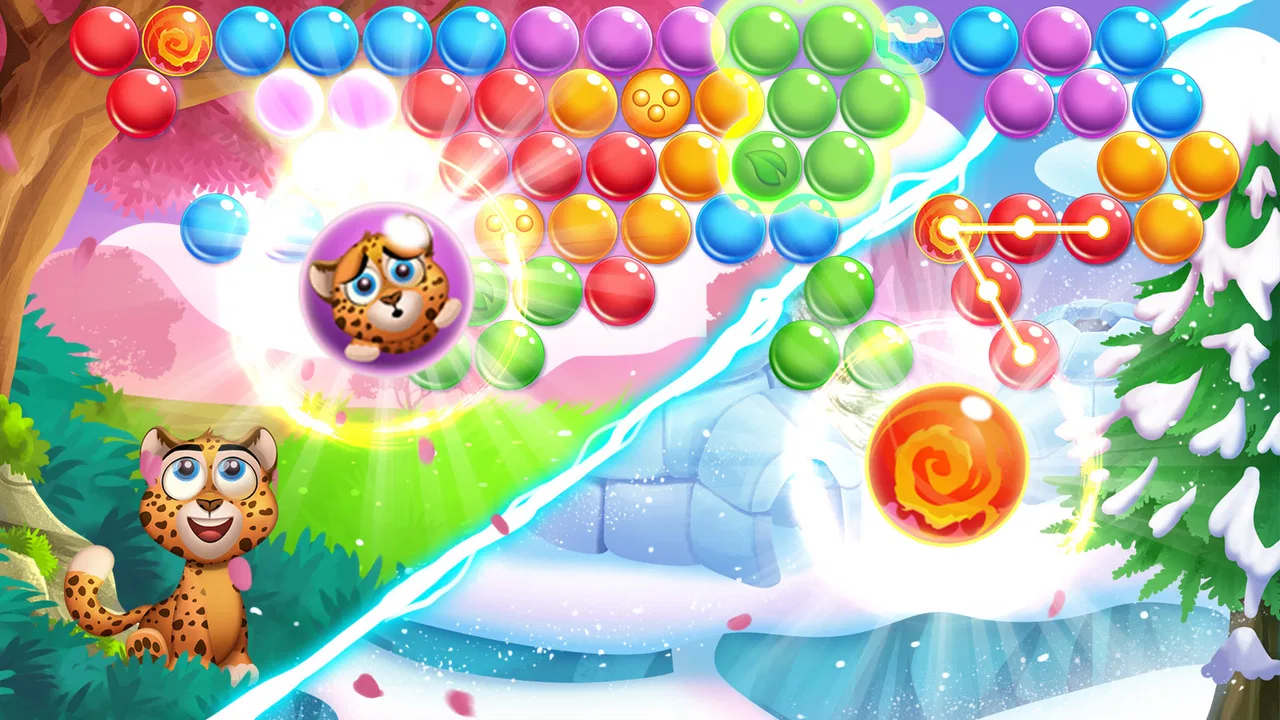
I usually know within the first few minutes whether a bubble shooter is going to earn a place on my phone. Bubble Pop: Wild Rescue made a good first impression because it keeps the basic idea easy to understand: aim, match bubbles, clear the board, and work toward rescuing animals. That simple goal gives each level a little more purpose than merely chasing a high score.
This is a free puzzle game from Gimica GmbH, aimed at Everyone and available for devices running Android 7.0 or later. It has reached over a million installs and holds a 4.4 average from around 147 thousand ratings, so it is clearly not an obscure experiment. I can see why it appeals to casual players: the rules are familiar, the sessions are easy to start, and the animal-rescue theme gives the usual color-matching formula a friendly identity.
My experience with it is best summed up this way: it is a comfortable, low-commitment bubble shooter with enough short-term goals to keep me playing, but it is not designed for people who need deep strategy or constant novelty. Its strongest quality is the way it turns a very recognizable puzzle loop into something approachable. Its main weakness is that the same simplicity can become predictable if I play for too long in one sitting.
You May Also Like

 Blood Strike: 2.5 Anniversary
Blood Strike’s Loadouts Turn Every Drop Into a Tactical Gamble
A close look at Blood Strike’s custom loadouts: how fast access to signature weapons reshapes its battle royale rhythm, rewards preparation, and narrows the gap between fights.

 Pandora - Music & Podcasts
Pandora’s Music Is Easy to Start, but Harder to Recover
Pandora’s strength is its low-effort path from a seed to a station. Its weak spot is how much confidence it asks you to place in connection, setup, and quiet recovery.

 8 Ball Pool
 Is Built on Rivalries, Rematches, and Routine
A close look at the rivalries, rematches, shared routines, and unanswered safety questions that turn a quick pool match into a persistent mobile community.

 Samsung Music
’s Quiet Strength Is Playing What You Already Own
Its reach comes less from spectacle than from dependable access to a personal library. That simplicity is both the app’s strongest retention engine and its ceiling.

 AccuWeather: Weather Radar
AccuWeather Review: A Quick, Clear Forecast for Everyday Decisions
For everyday plans, the best forecast is the one you can understand quickly. AccuWeather makes rain timing, radar, and local conditions easy to act on, with a few trade-offs.

 Hill Climb Racing
Why Hill Climb Racing Still Turns Crashes Into One More Run
A tiny car, a bumpy hill and one more upgrade: Hill Climb Racing keeps resurfacing because its simple chaos makes every near-miss feel personal.
More From Our News Desk



How the early goals make the first sessions work
The opening appeal comes from how quickly the game communicates what I am supposed to do. I do not need a long explanation before taking the first shot. The board presents a cluster of bubbles, the launcher gives me a clear target, and the rescue theme gives the level a reason to exist. That matters because bubble shooters work best when the first few moves feel immediate rather than instructional.
I found the early goals useful because they create a small sense of direction without demanding that I learn a complicated control scheme. A level is not just an empty puzzle screen; I am working toward clearing enough of the arrangement to help the animals. That framing makes a failed attempt feel less like wasted time, even when the underlying action remains familiar.
The controls suit touchscreens well. I can adjust the angle with a finger and make a shot without dealing with menus or awkward movement. On a phone, that makes it suitable for the moments when I have only a few minutes, such as waiting for an appointment or taking a short break between tasks. I would not describe it as a game that requires complete concentration from the first second, but careless shots still matter once the board becomes less forgiving.
One practical tip is to resist firing immediately just because a matching group is visible. I get better results when I first check whether the shot can remove a supporting section or open a more useful path. In a bubble shooter, the most obvious match is not always the best move, and this game rewards that small pause more than frantic tapping. That is one of the first places where the puzzle gains a little more thought than its cheerful presentation suggests.
The animal theme also helps with younger or less experienced players. The Everyone rating reflects the approachable presentation, and I would feel comfortable showing it to someone who wants a gentle puzzle rather than an intense action game. Still, “easy to understand” does not mean every level stays effortless. The early stages are mainly about learning the rhythm of aiming and matching, while later play asks for more careful use of the available shots.
What progress feels like during ordinary play
Progress in Bubble Pop: Wild Rescue is communicated through the steady movement from one puzzle to the next and the continuing rescue objective. I like that the game does not need a complicated inventory or a large collection of systems to make advancement visible. Completing a level is itself a clear signal: I solved the arrangement, moved forward, and can attempt the next challenge.
That kind of progress works particularly well for players who enjoy a sequence of small victories. I can play one level, put the phone down, and return later without needing to remember a large story or a complex set of tasks. The structure supports short sessions, but it also gives me a reason to continue when I have more time.
The important distinction is that the game’s progress is more about advancing through puzzles than building a highly customized character or managing a deep long-term strategy. If you want elaborate unlock trees, equipment choices, or a role-playing layer, this will feel light. I see that as a deliberate trade-off rather than a flaw, but it does define the audience. The game is more satisfying for someone who enjoys solving the next board than for someone who needs a constantly expanding set of personal upgrades.
Another useful habit is to treat failed attempts as information. When a shot leaves a stubborn cluster or creates an awkward ceiling, I try to remember which angle caused the problem instead of repeating the same plan. This sounds obvious, but the colorful presentation can encourage quick decisions. Taking a moment to inspect the remaining layout often turns a seemingly random failure into a lesson about positioning.
The rescue framing adds emotional continuity, although I would not play this expecting a story-heavy adventure. The animals give the levels a recognizable purpose and make the overall tone warmer than a plain geometric puzzle. For me, that is enough to make the game feel distinct, but players looking for character development or a substantial narrative should choose a different kind of mobile game.
Where the difficulty curve becomes meaningful
The challenge is most enjoyable when I stop treating every board as a reflex exercise. Early play can feel almost automatic because matching bubbles is familiar, but the puzzle becomes more interesting when the arrangement limits the clean shots available. At that point, I need to think about angles, supporting bubbles, and whether a move will create a better follow-up rather than only producing an immediate match.
I appreciate this gradual shift because it gives the basic mechanic room to develop. The game does not need to introduce a completely new genre idea to make a later level more demanding. A different arrangement can be enough to change the value of a shot. That is a modest form of progression, but it is appropriate for a casual puzzle game intended to be picked up quickly.
There is also a pacing advantage to keeping the controls familiar. I am not spending mental energy remembering special buttons while trying to solve the board. My attention goes toward planning the next shot. For a player who likes calm concentration, that can be more appealing than a puzzle game overloaded with timers, menus, and competing objectives.
However, the same design can feel repetitive. Once I understand the central loop, the enjoyment depends heavily on whether the current arrangement gives me an interesting decision. If I am in the mood for discovery, the game may seem too restrained. If I want a reliable few minutes of matching and aiming, that restraint becomes a benefit.
My best advice is to play in focused bursts rather than treating it as an all-evening marathon. Short sessions preserve the satisfaction of solving a board and reduce the chance that the repeated bubble pattern will start to blur together. It is also a good way to notice the difficulty changes, because rushing through many levels can make the progression feel flatter than it actually is.
The game suits people who like a challenge that grows through board structure rather than through complicated rules. It is less suitable for players who want a highly punishing puzzle experience from the beginning. I would also skip it if I strongly dislike retrying levels or making several attempts to find a workable angle. Bubble shooters naturally depend on repetition, and this one stays close to that tradition.
How retention pressure affects the experience
Because the game is free, the larger question is not whether I can start playing, but how comfortable the long-term experience feels. Bubble Pop: Wild Rescue uses the familiar appeal of “one more level”: a board is nearly solved, the next shot looks promising, and progress feels close enough to encourage another attempt. That is effective retention pressure because it comes directly from the puzzle rather than requiring a complicated social system.
There is a positive side to that design. I can return after a day away and understand the game immediately. I do not need to rebuild a routine or remember a large amount of context. The animal-rescue objective also makes returning feel more purposeful than opening an entirely abstract matching game.
The trade-off is that casual puzzle games can encourage repeated retries when I am close to success. I have to decide whether another attempt is genuinely enjoyable or whether I am continuing only because the previous board was almost complete. That is a personal boundary worth noticing, especially for younger players. The Everyone rating describes the content, not whether every player will enjoy the game’s repeating loop equally.
In-app purchases range from $2.49 to $4.99 per item. I would approach those purchases as optional convenience spending rather than part of the reason to install the game. The free entry point is the main attraction, and I would first play normally to see whether the puzzle rhythm holds my attention. If I ever felt that progress depended on spending, that would be a sign for me to step back rather than purchase automatically.
One practical way to keep the experience comfortable is to decide in advance whether I am playing for relaxation or for completion. If I am relaxing, a failed level is simply a short puzzle I can revisit later. If I am trying to advance quickly, the same failure can feel like pressure. This distinction helps me judge the game fairly: its loop is better when I let the pacing remain casual instead of turning every board into a test of endurance.
The current version is 1.9.0, and the game has attracted around 4.3 thousand written reviews alongside its larger rating total. Those figures suggest an active audience, but numbers alone do not tell me whether the design matches my habits. I would use them as a sign that the basic format has broad appeal, not as proof that every player will enjoy the pacing.
Who gets the most from this puzzle
I think Bubble Pop: Wild Rescue is a good fit for someone who wants a free, touch-friendly puzzle that can be played in compact sessions. It works for casual players, families looking for an approachable game, and anyone who enjoys the familiar satisfaction of lining up a shot and watching a group disappear. The rescue theme gives the experience a little personality without making the rules harder to learn.
It is also useful as a low-pressure break game. In an everyday scenario, I might open it while riding as a passenger, waiting for food, or taking a short pause from work. I can complete a small amount of progress without committing to a long campaign. The game’s strongest use case is exactly that: a simple activity that asks for enough attention to be engaging but not so much that I need a quiet room and a long uninterrupted session.
I would be more cautious about recommending it to competitive puzzle fans. If you want deep planning, a large variety of mechanics, or a system built around personal optimization, this may feel too narrow. A traditional logic puzzle app would be a better choice for pure deduction, while a match-three game may offer more variety if you prefer board reshaping and multiple simultaneous objectives. A physics-based bubble game may also suit you better if you want experimentation rather than careful aiming.
It is not the right choice for someone who dislikes free-to-play structures in general. Even when the core activity is enjoyable, the presence of optional purchases can affect how some players feel about continuing. I would also avoid recommending it as a story game. The animal-rescue idea provides a pleasant frame, but the main attraction remains solving bubble layouts, not following a detailed narrative.
My verdict on the progression and pacing
After spending time with it, I see Bubble Pop: Wild Rescue as a polished example of a familiar casual puzzle format rather than a radical reinvention. Its early goals are clear, its progress is easy to read, and its challenge grows mainly through the arrangement of the bubbles and the decisions required to reach useful matches. That is enough to sustain play for people who enjoy small, repeatable victories.
The progression works best when I pay attention to the board instead of playing on autopilot. Looking for support points, planning an angle, and saving a promising line of attack are simple habits, but they make the difference between a disposable time-killer and a puzzle I actively engage with. Those choices are also where the game offers its most satisfying moments.
Its limitations are equally clear. The central loop can become familiar, the long-term progression is intentionally light, and the free-to-play structure may not appeal to everyone. I would not choose it over a deeper puzzle title when I want complex systems or a fresh challenge every few minutes. But when I want a friendly bubble shooter that I can understand instantly and revisit without preparation, it does the job well.
Gimica GmbH has kept the focus on accessible play, and I think that focus is the reason the game has reached over a million installs and maintained a 4.4 average. I would recommend it to a friend who enjoys colorful matching games, animal-themed presentation, and short sessions with a gradually increasing challenge. I would suggest starting for free, playing in brief bursts, and deciding based on the feel of the levels rather than assuming that more progress will automatically mean more variety.
Overall, the game earns its place as a dependable casual puzzle. Its best quality is the balance between immediate play and modest strategic thinking: I can take a quick shot when I want something relaxing, or slow down and plan when the board demands it. That balance will not satisfy everyone, but for the right player, it makes rescuing the next group of animals a pleasant reason to keep coming back.
FAQs for Bubble Pop: Wild Rescue
01What is Bubble Pop: Wild Rescue about?
Bubble Pop: Wild Rescue is a casual match-three bubble shooter built around a wildlife rescue theme. You aim and fire colored bubbles to match groups of the same color, clear obstacles, and complete level objectives. As you progress, the game presents new stages, rescue-focused challenges, and increasingly complex layouts designed for short, relaxing play sessions.
02Is Bubble Pop: Wild Rescue free to download and play?
The game can generally be downloaded and played for free, although optional in-app purchases may be available. These purchases can provide extra boosters, coins, lives, or other helpful resources. Players who prefer not to spend money can still enjoy the main experience, but progress may require more patience when levels become difficult or when free lives and power-ups are limited.
03Does Bubble Pop: Wild Rescue require an internet connection?
Many bubble-shooting levels can usually be played without a constant internet connection, which makes the game convenient for travel or offline breaks. However, an internet connection may be needed for advertisements, cloud-related features, updates, rewards, purchases, or certain events. Availability can vary by device and version, so offline functionality should not be assumed for every feature.
04Is Bubble Pop: Wild Rescue suitable for children?
Bubble Pop: Wild Rescue is easy to understand because its core gameplay relies on aiming, matching colors, and completing simple objectives. Its animal-rescue presentation may appeal to younger players, but parents should still review the store age rating and privacy information. Advertising, optional purchases, and any external links should also be checked before allowing children to play independently.
05What should I know about ads, purchases, and device compatibility?
The game may include advertisements and optional purchases, as is common with free-to-play puzzle titles. Ads can sometimes be used to receive extra rewards, while purchases may speed up progress or provide additional resources. Before downloading, check the current Google Play or App Store listing for supported operating-system versions, storage requirements, in-app purchase details, and the latest privacy disclosures.
Pros
- Simple controls make it easy for new players to start quickly.
- Rescue-themed levels give the classic bubble-shooter format extra purpose.
- Short stages work well for quick gaming sessions.
- Bright visuals make the game appealing to casual players.
- Progressive challenges help maintain interest beyond the opening levels.
Cons
- Some levels may depend heavily on favorable bubble colors.
- Repeated shooting patterns can feel familiar over longer play sessions.
- Extra moves or boosters may be limited without careful resource use.
- The colorful effects can become distracting during extended play.
- Players seeking deep strategy may find the core gameplay too simple.

Bubble Pop: Wild Rescue
Gallery